(The following is a sermon I preached to kick off our stewardship season here at the American Church.)
A few weeks ago the Times ran this headline: ‘We’re too rich to be happy, say the Tories, and only radical taxes will save us.’
Really.
Now for those of us whose ears are still tuned to American political thinking, can you imagine a candidate saying that in the States?
There were the usual protests from MPs who argued that jobs would be lost in their constituencies, but no one made the valid point that having too much wasn’t the core problem—that the real issue was what people do with what they have—what they do to share their stuff.
Luke 12:13-21
Someone in the crowd said to Jesus, "Teacher, tell my brother to divide the inheritance with me." Jesus replied, "Man, who appointed me a judge or an arbiter between you?" Then he said to them, "Watch out! Be on your guard against all kinds of greed; a man's life does not consist in the abundance of his possessions."
And he told them this parable: "The ground of a certain rich man produced a good crop. He thought to himself, 'What shall I do? I have no place to store my crops.'
"Then he said, 'This is what I'll do. I will tear down my barns and build bigger ones, and there I will store all my grain and my goods. And I'll say to myself, "You have plenty of good things laid up for many years. Take life easy; eat, drink and be merry."
"But God said to him, 'You fool! This very night your life will be demanded from you. Then who will get what you have prepared for yourself?'
"This is how it will be with anyone who stores up things for himself but is not rich toward God."
Now there’s a text for the first day of a stewardship campaign, don’t you think? It’s not an accident that we’re reading this parable today. I’m not trying to be sneaky here—the point of this parable for us today is that it’s important to look at what we have, how we manage it and depend on it, and also to decide how much of that we will invest in the vision and ministry of this church.
Before we dive into what this means for us in this church, let’s look at the story behind the story.
Even though Jesus doesn’t mention it specifically, this parable is about building our lives according to the values of the Kingdom of God. God’s Kingdom isn’t a realm or a place with boundaries and limits. It’s God’s reign over his creation and his power over all things, even death.
This parable opens with a question from someone in the crowd. A guy asks Jesus to mediate in a family dispute between two brothers. I love Jesus’ response here: Man, who made me the solver of your family problems? Jesus saw that at the heart of the question was a problem with greed, and reminds us that our lives aren’t measured by how much stuff we accumulate. And so he tells the crowd a story about a successful guy.
The main character is a good man by the standards of his day: he works, he plans, he saves, he protects his belongings. He expects to enjoy the future he created and protected. We admire people like this! In the detail of the story this is a good farmer—a prudent businessman—a pillar of his community.
But then he had an unusually good year and found himself with a strange problem: he didn’t have anyplace to put his extra stuff. He had barns filled with the crops he’d already grown, and the wealth he’d already accumulated, but now he had to make decision about what to do with the extra. That’s where he gets himself into trouble.
Notice how many personal pronouns he uses in this section. OK, I know that’s the kind of nerdy observation you’ve come to expect from the son of an English teacher, but just count them. The guy makes 11 references to himself in just 3 verses. It has to be some kind of record. But it illustrates the point of what happens when greed overtakes us—when it takes over our sense of balance, our sense of responsibility to our neighbor.
The man decides to tear his old storage facility down and build a bigger one. He decides to take it easy—to eat, drink and be merry—he allows himself to rely fully on his wealth instead of on God.
But then God enters the story and says: ‘You fool, your life is over—who will get what you planned to give yourself?’ Now at this point it’s important to say that the rich man didn’t die because he hoarded everything for himself. As nice as it might be for our stewardship plans to hold that one over all of us, it’s just not the point of the story. The point is that the guy didn’t know when his life would end, which made hoarding his extra stuff the focus of the story.
It’s also important here to say that there was nothing wrong with the way this man had been managing his finances up to that point. There’s a justness, a practicality in this parable, especially to people who enjoy a generous portion of God’s provision (that’s a nice way of referring to people who make a comfortable living). Nothing wrong with providing for yourself and your family. In this parable it’s what we do with the extra that matters. It’s what we do with the extra that marks our commitment to God and his Kingdom. The guy in the parable forgot all that and built bigger barns so he could keep it for himself.
That ends up being the kicker in the story. Jesus is critical at the end of the parable toward those who store up things for themselves without ‘rich toward God’. There are two problems this parable identifies for us.
First, the problem here is with someone who is so consumed by possessions and money that they become the source of his meaning and value.
Second, being so committed—or enslaved—to one’s possessions makes us deaf to the call of God on our lives, and also to the needs of our neighbors.
This parable is spoken to people who have extra—to people who have provided for themselves and their families, and are deciding what to do with the rest of God’s generosity.
So what should we know and do about it?
First: The life of discipleship includes supporting the vision of our faith community, our church. The life of faith makes all kinds of demands on our lives. One of them is to participate in the support of God’s work through the church. Giving is as much about the giver as it is about the recipient—it’s one of the marks of mature discipleship.
Second: The collective vision of this place is what we support when we give. Take another look at the list of announcements in the bulletin. There’s a lot going on here that is designed to help each one of us experience and enjoy the foundations of a healthy church: fellowship, worship, discipleship and service. You won’t hear much about need over the next few weeks, but you’ll hear a lot about what this church offers as a way of meeting the spiritual and physical and emotional needs of the people who come into this place, and how we can do that more effectively and faithfully.
Finally: the parable we read translates into a faithful consideration of Pledging—making a commitment to give at least a fixed amount for the coming year—pledging allows the leadership of this church to implement a vision, to make plans and dream big about how we’re going to serve each other and this community.
In that article I mentioned from the Times, the political solution to helping people handle their extra money went like this: ‘The main proposals include new taxes on domestic flights, varying rates of vehicle excise duty to punish those most polluting in each class of car, and limits on expanding airports and motorways. Private, non-residential parking should be taxed to discourage car use, and out-of-town supermarkets should be required to charge customers to park.’
I have a better idea.
Over the next few weeks you’re going to hear about the great things going on here at ACL. Take some time to think and pray about how you want to be involved. Your time, your talent and your financial support will play a role in the ways this church can live and share the message of Jesus Christ with each other, with this community, and with the rest of the world.
Tuesday, October 30, 2007


Friday, October 26, 2007
A Little Kindness
In a big city kindness comes in small portions. I suppose that’s different in rural areas—we city folks have the impression that in the country people show kindness in big ways: helping plow the farm, raising barns and the like. Those are huge, but in the city life is completely different. Holding a door open…picking up a dropped glove or scarf or a child’s toy…taking your time getting on the bus so that someone else can make it in time. That’s the sort of thing that happens in a city.
The other day I saw a young woman get on my bus and drop into a seat. She looked exhausted, like a lot of people do here in London. She didn’t look English—my guess that she was one of the thousands of immigrant workers here from Poland or China or Africa, the sort who clean and fix and build most of the city around me. She was dozing in her seat when an elderly woman boarded the bus and labored her way down the aisle. Without a thought—without any consideration of her own tiredness—she got up and offered her seat to the woman. The lady sat down and thanked the young person with a smile that would melt the hardest heart. It was one of those truly beautiful moments that happen in a big, impersonal city. Nobody got a barn built on the bus that day, but someone gave something of themselves to make another person’s day a little better.
What a humbling thing that was to see.
I get frustrated here—with the level of service, with the general melancholy and materialism of the culture, with the overt rudeness of people who seem to have little time or care for others. It’s such an easy place to be cynical—easier by far than any American city I’ve ever been in. I can have days here when I wonder if there is any hope for the gospel—any point of contact that might let me say: ‘you know, that’s sort of like what happens in the Jesus story.’
And then I see a tired young woman give up her seat to a pensioner.
I was reminded today that God made everyone in his image. What that means is not that all people are basically good deep down. I’m certainly cynical enough to reject that idea. But what it does mean is that occasionally, in small ways, we can see something that reminds us of what God wants us to see—how he wants us to behave—and we can share it with someone else. People might not all be good, but there is in every person the potential to be good, to be decent, to be generous to a stranger. I know that may seem small, but that’s the point. With so many people crowded together in this ancient/modern city, it’s the small things that matter. It’s the small kindnesses that stand against the torrent of contrary evidence and remind us that there is a God, that he loves us, and wants us to love each other.
Friday, October 19, 2007
One Disciple's Soundtrack
The following begins an occasional series of reflections on the music that has influenced my life as a Christian. From time to time a song pops back into my head, and I want to try and capture why that song was important to me then, and maybe even now.
So I’ve been listening to a lot of music lately. That’s not really something new, but I’m finding that it’s not as easy as it was in LA to listen to my favorite songs and especially to hear new ones. I don’t drive here. Sometimes I get home from work just as Ian is ready for some play time. There just aren’t the same opportunities to listen to music.
So I’m learning some new ways to keep music in my life.
It helps that I’m using my iPod more, and I’ve started playing music in the background when we have dinner. I can also listen to Jack-FM from LA here at my desk via the internet, which is great. In the mornings here, there are several music-oriented TV shows where I’m catching up with some newer songs as well.
Listening to more music is bringing back a flood of memories. We listened to a lot of music in our home when I was growing up—I can remember singing songs by the Eagles, Queen and Neil Sedaka (not very often you see those three in the same sentence), sitting around our living room. My sisters and I will always have a soft spot for ‘Bohemian Rhapsody.’
As I got into junior high and high school music functioned for me in the same way it does for a lot of adolescents: it gave words and emotion to things that I thought affected only me. Jackson Browne was especially influential. I learned to sing and play most of his songs on guitar, and to this day the only song I can play on piano is ‘Looking Into You’ from his first album.
When I made a commitment to Christ as a teenager and started to grow in my faith during high school and college, I started listening to some of the Christian rock/pop of the day. Back then, before people realized that it was profitable (and promptly ruined it), Christian pop music had an energy and creativity that mirrored that of other kinds of music. In the early 1980s it seemed that a new Christian band exploded out of Orange County every few weeks or so. This music—faithful, challenging, passionate and innocent—the Christian pop of the early 80s was the soundtrack to my early growth as a Christian. In the same way that secular music gave words to my teenage years, Christian songs gave me the language I was looking for to describe my attempt to be a disciple of Jesus.
Some of these performers might be familiar to you: Keith Green, Randy Stonehill, Bob Bennett, Sweet Comfort Band, Allies, Petra, Amy Grant, Mark Heard, Pat Terry... I’ve been listening to some of them again and have found myself transported to very specific times in my formation as a Christian. Over the next few months I want to share some reflections on why or when or how these songs made an impression on my life.
Why do this? Well, for one thing it lets me write about music, which I love to do, and maybe it’ll get you to dig some of these chestnuts up and listen to them again for yourself. Some of you weren’t even born when these songs were popular, though some have worked their way into the worship music canon. Find them on iTunes and hear them in their raw, un-homogenized state.
But the real reason is that today, as I was walking to my office, I listened to a couple of Keith Green songs on my iPod. One in particular—it’s hard to explain how this can happen on a London street—one of his songs put tears in my eyes and I had to stop for a moment before walking on. The song was called ‘Until Your Love Broke Through’, and it took me back to my early college days when I was still trying to figure out what this faith thing meant to me—and what I might mean to a God who seemed so distant and powerful and HUGE. This song—more than any sermon I heard or book I read back then—helped me put into words what I needed to know about an important part of who I am and whose I am. Here are a couple of verses and the chorus:
‘Until Your Love Broke Through’
(Keith Green and Randy Stonehill: 1976)
Like a foolish dreamer who was trying to build a highway to the sky,
All my hopes would come tumbling down and I never knew just why.
Until today when you pulled away the clouds that hung like curtains on my eyes,
Well I’d been blind all those wasted years and I thought I was so wise,
But then you took me by surprise.
Like waking up from the longest dream,
How real it seemed,
Until your love broke through
I’d been lost in a fantasy
That blinded me
Until your love broke through.
All my life I’ve been searching for that crazy missing part,
And with one touch you just rolled away the stone that held my heart.
And now I see that the answer was as easy as just asking you in
And I am so sure I could never doubt your gentle touch again.
It’s like the power of the wind.
It’s funny, but what I remember from back in 1980 or so when I heard this for the first time was that line: ‘with one touch you just rolled away the stone that held my heart’. I remember thinking then that I could picture God just flicking away with his little finger whatever kept me from being with him, from feeling his love for me. At that moment the ‘bigness’ of God became something I could rely on—could rest in—instead of something I needed to fear or avoid. No pun intended, but that was huge. It was a step for me in growing closer to God at a crucial time in my life, and it drew me into a deeper commitment (flaws and all) than I ever thought I would make.
It was that line that got me again this morning as I walked down Cleveland Street from Euston Road in the middle of London. That stone rolls back into its place every so often, and it was a gentle reminder to me, pouring out of my iPod, that God is there, poised to flick it away again when I come to him in faith. Not a bad way to start the day.
Monday, October 15, 2007
A Parable About Grace
The Parable of the Workers in the Vineyard (Matt. 20:1-15)
Jesus said:
"For the kingdom of heaven is like a landowner who went out early in the morning to hire men to work in his vineyard. He agreed to pay them a denarius for the day and sent them into his vineyard.
"About the third hour he went out and saw others standing in the marketplace doing nothing. He told them, 'You also go and work in my vineyard, and I will pay you whatever is right.' So they went.
"He went out again about the sixth hour and the ninth hour and did the same thing. About the eleventh hour he went out and found still others standing around. He asked them, 'Why have you been standing here all day long doing nothing?'
" 'Because no one has hired us,' they answered.
"He said to them, 'You also go and work in my vineyard.'
"When evening came, the owner of the vineyard said to his foreman, 'Call the workers and pay them their wages, beginning with the last ones hired and going on to the first.'
"The workers who were hired about the eleventh hour came and each received a denarius. So when those came who were hired first, they expected to receive more. But each one of them also received a denarius. When they received it, they began to grumble against the landowner. 'These men who were hired last worked only one hour,' they said, 'and you have made them equal to us who have borne the burden of the work and the heat of the day.'
"But he answered one of them, 'Friend, I am not being unfair to you. Didn't you agree to work for a denarius? Take your pay and go. I want to give the man who was hired last the same as I gave you. Don't I have the right to do what I want with my own money? Or are you envious because I am generous?'
What do we make out of this parable?
The math of the landowner is a little bit on the fuzzy side, don’t you think? But that’s part of the story. The point of this parable is that we are all recipients of God’s grace—his generosity that is his alone to give. In our math we talk about getting what we deserve. In the math of the Kingdom we get far more than that. The best definition I know for the kind of grace God gives to us is: Undeserved Favor.
Think about that.
Undeserved favor doesn’t mean that we get what we deserve—it means that we get what God chooses to give us. The math we usually use to calculate our appreciation and our envy, our giving and our resentment, all of that math goes out the window in the values of the Kingdom. That’s the point of this parable. Everyone got their pay—but the landowner chose to be gracious to some folks who hadn’t worked as hard for it.
There are some things for us to learn from this parable.
Grace is not about human effort, the things we do or what we deserve. This is a story about the way grace works from God’s point of view. We can’t reason our way into this one—it has to be revealed to us. We are accepted, welcomed, loved by God because of his grace and his initiative. That fact radically changes the math of how we’re called to live in the Kingdom of God. Robert Capon wrote: ‘If the world could have been saved by good bookkeeping, it would have been saved by Moses—by the Law—and not Jesus.’
It’s easy to try to define the 11th hour converts as being somehow less deserving than the rest. They’re like the deathbed confessions or last minute conversion stories we’ve all heard. But in the context of the Gospel we are all such people, all of us hired at the eleventh hour for a full measure of blessing, all of us totally dependent on unmerited grace.
The call to us is live remembering that we have received grace from God, and to extend that grace to others. The warning here is that when we aren’t radically generous with grace to other people, we probably haven’t considered the grace we’ve received. Don’t let that happen in your life.
One of my favorite writers, Frederick Buechner, wrote an essay about this parable. He said this:
‘People are prepared for everything except for the fact that beyond the darkness of their blindness there is a great light. They are prepared to go on breaking their backs plowing the same old field until the cows come home without seeing, until they stub their toes on it, that there is a treasure buried in the field rich enough to buy Texas. They are prepared for a God who strikes hard bargains but not for a God who gives as much for an hour’s works as for a day’s. They are prepared for a mustard-sized kingdom of God no bigger than the eye of a newt, but not for the great tree it becomes with birds in its branches singing Mozart. They are prepared for the potluck supper at the First Presbyterian Church of Wherever, but not for the marriage supper of the lamb.’
As we move into the seasons of Thanksgiving and Advent and even Christmas, my prayer for all of us is that we are prepared for the grace we’re about to receive and celebrate. We can thank God now for the generous math of the Kingdom, for the undeserved favor we have all received, and we can share that grace with the rest of the world.
Amen.
Monday, October 08, 2007
A Very Cool Saturday

Ian and I had a fun weekend. Julie spent Friday evening and all day Saturday at a women's retreat at our church, so Ian and I had some dude time. Friday evening we ordered Chinese food and ate it while we watched the second Harry Potter movie on DVD.
Saturday we watched some cartoons in the morning, then a show on Children's BBC on creating art at home. The painting there were using as an example was called "Surprise" by Henri Rousseau. Ian said that they had learned something about the artist in his class, and that it was his favorite painting. I looked it up online and it turned out to be here in London, so we decided to go see it (after eating the leftover Chinese food for breakfast).
One bus ride and we were at the National Gallery in Trafalgar Square. We went to the information table and I said "we're really here to see one painting," and that's when Ian chimed in with "it's by Rousseau." The man said, "you came to see 'Surprise' didn't you," and told us how to get there. We walked through rooms with paintings by Monet, Chagall, Van Gogh, Renoir and a bunch of other greats. When we came to the room with the painting we were after, Ian got this big smile on his face and we stood in front of it for a while. We looked at some other pieces and then left.

When we got outside there was a huge demonstration in the Square about the persecution in Burma (that's the picture at the top of the post). There were speakers and Buddhist chants, and we looked on for a few minutes. We walked up through Leicester Square and through Picadilly Circus to the Tube, then up to Homebase (a poor excuse for a home improvement center) to get some things for the house. After a bus ride home we relaxed and had lunch together.
I tell that story because I've shared so many of the things that have been hard about being here. On Saturday I was struck by how cool it is to be in a city where you can see a famous painting on a kids' show in the morning, and see it in person before lunch. Ian and I had a good time together. I've been working so much lately that it was good to go out and be father and son for the day. I loved every minute of it.

Sunday's Sermon: Plenty of Room
One of the challenging moments in planning a party is creating the guest list. I’ve worked on guest lists with church groups, family parties and other gatherings, and it’s always tricky to know where to draw the lines—who to include and who to leave off. Anyone here who can remember planning their wedding knows exactly what I’m talking about.
Our text this morning has a party, a great banquet, it’s called, and the reaction of a host who just wants as many people as possible to enjoy his food and drink. It’s a parable that Jesus told as an allegory, or a story where the characters represent something bigger and broader than just the people involved. The guest list is the issue here—let’s read the story.
Luke 14:15-24
A wealthy man is throwing a party, and he invites the sort of people you might expect him to invite—people he knows, who are in his circle of friends. They make excuses, and so he fills his party with anyone he can find.
Now we should say here that none of these are bad excuses. These people were busy—they had properties to manage, businesses to run, they had relationships that needed care. In this cultural setting marriages were considered so important that men were exempted from military service and even work during the first year after the wedding. These aren’t ‘the dog ate my homework’ kinds of excuses. In today’s language, they were about investments, business trips, important jobs and family vacations.
The problem wasn’t that they were bad excuses. The problem was that when the master calls us, nothing else should get in the way.
The host responded with a radical idea. It may have been normal to fill the seats of no-shows with people of the same social standing, but this host reaches out to people who would have been excluded from the first list: the poor, the crippled, the blind and the lame. These were people who couldn’t escape their need for help—they never had any illusions about being self-sufficient; self-satisfied; independent. These people knew that they needed help from outside themselves
‘And still there is room.’ That’s the key to this passage. Notice where it comes in the story: The original guests have said no, and the banquet has been filled with the outcasts and the poor and the broken people of the community. That’s when the servant tells his master: ‘what you ordered has been done, but there is still room’.
The master’s response is to send the servant even farther in the search for guests—to the countryside and alleys. He wants his house to be full.
Most of the time we think that this parable is teaching us to be inclusive, to reach out to the unfortunate, to care about the blind and the poor and the crippled and the lame. Those are all important things, and they appear very clearly in other texts, but they’re not what this parable is about.
The parable of the Great Banquet is about setting priorities. It’s about recognizing that our relationship with God comes first—not after we’ve done everything else on our list. He gets our first attention, our first effort, our first money. It wasn’t that the field or the oxen or the marriage weren’t important—they weren’t lame excuses. It was that they represented priorities that were upside down and sideways.
God made room for us, but we have other things to do. But that place is still there—still there is room, the parable teaches.
Thank God.
What does this mean for us in the church?
First, the call from God is to be with him—to commune with him. This story—and all of Scripture—shows a God who is determined to have fellowship with all of his people. Notice just how much the host wants people at his dinner party. Whatever else we this place is—source of fellowship, a great place to sing, an American club...whatever else we call this place, we shouldn’t forget that it is the church of Jesus Christ, a place where we come to meet the living God in a real and powerful way. A place where we join together as people on the journey of faith to learn how to love better, worship better, serve better.
Second, we make all kinds of excuses, and leave others take our place in the call of service. This is a challenge to those in the church who hear the invitation and politely refuse it. It’s a challenge to those of us who have forgotten that we need God, that we need a savior. Maybe it’s a challenge to listeners who still won’t acknowledge that need—the self-sufficient, the self-satisfied, those who would never admit that they could be dependent on God. The point of this parable isn’t the detail of any excuse, it’s the danger of using those excuses in the first place—the danger of excusing ourselves from the Lord’s Table, and all that that means, because we have better things—more important things—to do. What could be more important than living as a faithful disciple of Jesus Christ?
Finally, ‘and still there is room.’ There is no limit to the grace extended by God to the world—he wants everyone there. This is such an important part of the story. Even though the last part of the text talks about the original guests not enjoying the banquet, that’s because it’s their choice—not because the table was full.
The point of this story is that God’s mission to his creation is never finished. As one writer put it, God is determined to have fellowship with his children, even if they turn him down at first.
That leaves us with a couple of very important questions:
Will we make excuses that prevent us from hearing God’s call?
Will we make still more excuses that keep us from sharing what we hear?
Wednesday, September 26, 2007
Arsenal 2 Newcastle United 0


Last night I went to my first Premier League football match where I saw my local team, Arsenal, defeat Newcastle United. The match was scoreless for the first 82 minutes, when Nicklas Bendtner scored on a wicked header. A few minutes later Denilson, a Brazilian player, launched a hard shot past the keeper (who I’m still not sure ever saw the ball). The stadium is brand new—it’s easy to get in and out of, immaculate and comfortable. I had fish and chips and a beer for dinner—it doesn’t get too much better than that.
I loved every minute of it.
I went with Tom Barlow and Dan Passerelli, two Americans in London with their families to plant churches and share the gospel. It was a pretty good guys night out. Apart from the fun of it, being in one of the new cathedrals to the real religion of the UK showed us just how far the church has to go to get the attention of this culture. English football fans sing for almost the entire game. Some of the melodies are familiar, but the words are usually some form of either worship of their team or insults to the visitors. There were about 3000 fans from Newcastle in northern England there, and they gave almost as good as they got.
After the first goal, about 50,000 Arsenal fans stood up and chanted ‘Who are ya?’ at the visiting crowd, with fingers pointed their way. I hadn’t seen that before—it was a fairly harmless (in the occasionally vicious world of Brit football) thing, but it got me thinking. I wonder how many people in that place had a satisfactory answer to that question.
Who are you?
One nice thing about questioning someone else’s identity is that it keeps you from having to pay any attention to your own. As Christians we’ve been given a new purpose, a new life...a new identity, even, but we rarely take much time to focus on what that means. It’s easier, after all, to shout at someone else than it is to look in the mirror.
In one of the great moments of identity defining in the Bible, we read: ‘But you are a chosen people, a royal priesthood, a holy nation belonging to God, that you may declare the praises of him who called you out of darkness into his wonderful light. Once you were not a people, but now you are the people of God; once you had not received mercy, but now you have...’ (1 Peter 2:9-10)
I wonder how many of us who struggle along, trying to follow Jesus, actually think of ourselves this way. Do you? I don’t think it crosses my mind very often at all. What I like best about this passage, when it does manage to work its way past the static in my brain, is that the images are all about community: a people, a priesthood, a nation, and most importantly, people who have been shown mercy. The life of discipleship isn’t about being alone or isolated or even independent (that one ought to get your attention). The life of faith is about living the way God made us to live—in community with each other and with Jesus.
It probably wouldn’t have been a good idea for me to try and answer those 50,000 fans with a little homily from 1 Peter, but it has to get out there or we’ll lose (ironically) the very message that gives us our identity as Christians.
I think that’s what I like and admire about Tom, MaryAnn, Dan and Somer. They’re here in London without the structure (and mask) of the organized church, meeting people, building friendships and living the message they came to share. I want to be more like that in my church, even as I spend too much of my time on the business of running this place. As fun as our dinners and coffees have been, and a much as I enjoyed learning to be a sports fan in a new place, I think what I’m enjoying most is learning from these people how to do ministry in a new way. God is being generous with me right now, and I want to savor every minute of it.

Wednesday, September 12, 2007
Home Cooking
Something happened today that made me feel strangely at home here in London. First, some background.
It’s fall here—and as it turns out, it’s much warmer and nicer than the summer ever managed to be. The temperature is just below 70F, which is perfect for walking and eating outdoors and, well, for having a life apart from wearing a parka and being trapped indoors. The weather is simply lovely.
We’ve been back for almost two weeks now, and we’ve settled in so much quicker than we expected. Yesterday Julie and I went to a tea at Ian’s school (think: Back to School Night), and then walked along Marylebone Road (a major thoroughfare) to Marylebone High Street (a very cool stretch of shops and restaurants). We found a place we liked and got a table outside for dinner—pizzas and pasta and salad (surprise). Halfway through dinner (and more than halfway through a bottle of Montepulciano), Julie said: “It shocks me to say this, but for the last few days I have loved being in London.”
Well.
It was a nice moment, after a fun visit to Ian’s school and a delicious dinner. It was a small milestone in our sense of making this place our home for the next few years. Ian’s school, by the way, is so great! We met his new teacher, some parents, and had a nice chat with his teacher from last year. Their first field trip is to this amazing re-creation of a Celtic village outside of London. The history component for his year is focusing on invasions of the British Isles (Celts, Vikings, the odd Norman). He’s going to have a really good year.
So back to my story. Around the corner from the church is a chip shop, a take-away place where you can get fish and chips, kebabs (think Zankou Chicken if you’re in SoCal right now), and other examples of, er, fine British cuisine. I’ve gone to this place a half dozen times since we moved here—it’s great food, but not all that healthy. Today I went there and got fish and chips for the secretary, property manager and the organist. When I’d ordered, the guy behind the counter asked me: “So are you watching the football tonight?”
That was one of the nicest things anyone has said to me since we moved here.
Like I said, I’d been in there a fair number of times, and on every one of those visits this same guy has asked me some variation of this question: “So are you here on holiday?” It must be his standard question to Americans who visit his shop, but I’ve taken it from him and answered with a quick “no, we live here now.”
But this time he asked me a “local” question. England is playing Russia in a qualifying match for the European Cup, and just about every guy in London will be glued to his set, drinking beer and yelling at the national team. His question told me that he no longer saw me as a visitor or an outsider, but rather as one of his local customers, and it made me feel pretty good. So much about who I am identifies me as someone who is not from these parts—not least that I’m the pastor of the American Church—but the chip guy treated me like a local today, and that made it just a little bit easier to see myself that way.
It’s strange, isn’t it? How something as minor as a piece of smalltalk can make you feel as though you’re a part of something. I’ve been thinking this afternoon about how we welcome people into new communities. That’s a huge part of my ministry here—we had more than 20 visitors last Sunday, and more are on the way—and I want to be good at it, to make new people feel as much at home as the chip guy did with me today. Maybe it takes a few visits before you can do that authentically with a new person. I’m sure part of what happened today took place because the chip guy knew he’d seen me before, and part of him was sure that I couldn’t still be here on holiday.
And so maybe what I learned today is not how to greet the first-time guest—frankly I think we’re pretty good at that. Maybe what I learned today is how to help someone transition from visitor to “local,” to someone I want to know something about—someone I expect to see again. That may be an under-examined aspect of how we bring people into community and into faith. The simple asking of a question—one that had to do with an event that only locals might care about—told me that I belonged there, that I was known, and that I was recognized as a fellow Londoner.
At the American Church we’re just about ready to enter into our prime season of drawing new people into the life of the church. Americans tend to move here in time to get their kids in school, and so by September and October they’re looking for places to belong. I love meeting these folks, but I think that after today I’m going to pay special attention to the repeat visitors, and look for that question or comment that will let them know that they’ve found a home.
That’s what happened to me today.
Wednesday, September 05, 2007
Cigar Night
 What can I say about my Cigar Night friends that could capture the meaning of it for the rest of you? If I was honest I'd say that I have learned as much about the church there than I ever did in seminary. Where else can you find a group of people--anywhere--who share their faith, their struggles, their fears, their jokes, their discoveries and their dreams for being better disciples of Jesus Christ? They do all of that without judgement or meanness, even when the disagreements are heated. I'll never forget the evening when one guy dug his feet in on something that the rest of us thought was crazy. He took a pummeling in the conversation, but he also got a hug from each one of us on the way out.
Did I not say that this was more like church was supposed to be than, well, church?
The guys who participate in this regular event--and the roster changes each time--are brothers in Christ in the truest sense of the word. They laugh easily, love loyally and forgive with just the right measure of forgetfulness.
I got to attend two of these gatherings while I was was back in LA. It wasn't nearly enough.
Cali Recap
We had a great time in California. It was hot--mostly in the 90s the entire time--but we loved being there and miss it a lot now that we're back in London. Julie got back into cutting hair, which gave her the chance to re-connect with lots of her friends. We spent a lot of time with the lovely people in our small group--they through one of Julie's three (3!) separate birthday parties. I got to ask my pastor, Craig Hall, a ton of questions from my first seven months in London, and as expected he gave me some wise counsel.
We flew back on 29 August, and we're still trying to wake up. Ian goes back to school on the 6th, so we'll be back into our early morning commute. We're kicking off some new things this season at ACL, including a Sunday School class for adults that will be modeled on the one I attended at Glendale Presbyterian. Kate Obermueller (see below) is coming in a few weeks, which will get us back to full strength on staff.
So many friends to see and some really good times with our families. Ian enjoyed saying goodbye to his cousins. Here are some snaps from the last few days.
Ian and Bella.

Ian and Brad.

Ian and Haley.
 The Boulais Boyz--destined to be rock stars.

Thursday, August 16, 2007
Kate O

I got to spend some time with Kate Obermueller this week. She’s coming on staff at ACL this autumn, and we hired her without the benefit of a face-to-face meeting. She had some amazing references, and we can’t wait to have her in London. Since she was traveling around and visiting family and friends before her move, we worked it out so that we’d be in LA at the same time.
I’m so glad we did.
We spent a full day talking about our lives and how we came to ministry. We talked about ACL, about a shared vision for ministry, about our responsibilities and dreams for the coming year. That night Julie joined us for dinner at a great local Mexican place, and she and Kate got to know each other. Today I took Kate to Fuller for a walk around and a look at the bookstore, and then Julie took her to Nordstrom Rack for a little pre-London shopping (yikes!).
The point of all this was to speed up the orientation process and get to know each other before we work together. The surprise has been how much we enjoy each other and feel comfortable talking about life, faith, ministry and, well, anything. Julie and I couldn’t be happier for this new partner in ministry, and ACL will be lucky to have her there.
Aunt Lynette and Shell Beach
That's Aunt Lynette in the middle, with most of my family on Christmas Day 2006.


Here are some shots of the ocean in Shell Beach.




I helped with a memorial service for my Aunt Lynette on Saturday in Shell Beach. Actually it’s probably not accurate to call it a service—we set up tables for more than 80 people on the vacant lot next to where she lived, and the event was catered by Alex BBQ (a fixture in that town for years).
Shell Beach has been a family vacation spot since my grandmother bought a house there in 1970 (when I was 7). I've spent parts of every summer since then (as well as other seasons of the year) swimming, fishing and relaxing in this low-key little town sandwiched between the 101 and the Pacific. It's truly one of my favorite places in the world.
My aunt Lynette (great-aunt, really) had been the matriarch of our extended family on my Mom’s side for more than 20 years. She never had kids of her own, but she was a wonderful grandma and great-grandma to a lot of us and our kids. All of us remember her stories, her laughter and her wacky way of taking a 5 minute conversation and stretching it out for an hour or so. We loved her a lot, and it was good to have a chance to say goodbye.
I baptized Lynette in her bed on Thanksgiving Day last year. She was raised in Christian Science, as was most of my Mom’s family, but through some friends and others (mostly my Mom), she came to faith in Christ over the past few years. I remember her talking for less than 2 minutes about her own sense of forgiveness (a record brief conversation), and for days and days about the people she needed to forgive. Reconciliation just wasn’t real for her unless she shared it—gave it away to people who had wounded her along the way. I remember a long chat and prayer for her mother—who hadn’t been very nice to her at all. Lynette was worried that her salvation wouldn’t ‘stick’ if she neglected to forgive everyone she’d ever known.
I wish we were all a little more like Aunt Lynette.
Now she wasn’t perfect, but I can’t help wondering what our churches and relationships would be like if we lived our faith like Lynette did? Personally I have no idea—I’m always amazed at my ability to hold tenaciously to a wound or a slight. Don’t you struggle with that, too? In my entire life I have never known anyone who wanted to be forgiving as much as Lynette, and I want to remember her example as I move ahead with my own life.
Being in Shell Beach again was great for all of us. Ericka came up with us and shared our hotel room—it was a slumber party for the four of us. My dad came up and had a great time with members of my mom’s side that he hadn’t seen in years. Neighbors came and enjoyed the celebration as we talked about our life and faith.
Lynette lived 94 years. She built friendships and loving family relationships all along the way, and taught us all some lessons on hospitality and love and forgiveness. We were blessed to know her and love her. We would be lucky to turn out to be even just a little bit like her.
Here are some shots of the ocean in Shell Beach.


Friday, August 10, 2007
Another update
So we've been staying with my in-laws since we got back. That wasn't really the plan--we were going to stay here for a week and then move in with my mom. But my mom's house is in the final stages of a major remodel and so it has made sense to be here a little longer.
We're in a large complex of condos in Glendale, and being around here has reminded me of something important. London is such an ethnically diverse city, and a complicated place to communicate effectively over a long period of time. I taught a Bible study at the church in the Spring, and out of the 12-14 people who came regularly, at least 7 countries were represented.
So I was walking through the complex here on my way to the laundry room, and I was struck by the number of languages I could hear: Spanish, Korean, Tagalog, lots of Armenian and even a little English. So many immigrant groups have made homes in Southern California, and I'm realizing that growing up here was a part of my preparation for service in London. Sure, there are very different ethnic groups in each place, but being accustomed to the presence of so much different-ness, so many people from so many nations and cultures, has helped me in my ministry within Greater London.
This visit has been really good for us so far. We've reconnected with friends and family, I've gotten a lot of work done toward my study leave plan, and I've been reflecting on what I'd like to accomplish when I get back to my responsibilities. Julie has been cutting hair for some of her old clients and hanging out with Ian by the pool here.
It's strange, but I think I may miss this place more after this visit than I did in December. But I also think that we're all a little better prepared for the move this time. We know what's coming--the good and the, well, not so good--and we're able to make ourselves ready in a way we couldn't before.
So...it has occurred to me that I'm thankful to God for so many things right now. For helping me use my past to prepare for the present and future, for allowing us to be reminded that we have friends in both places that we love and enjoy, and for giving us this time to rest and regroup and renew. God is good.
Friday, August 03, 2007
Our first week in California
So we've been relaxing a lot over here--catching up with friends and family and playing a little. It's good to be home, and we're soaking up every bit of it as we re-connect.
Ian is working on his artistic technique on the patio of my in-law's home, where we're staying for the first two weeks.
 I went to a Dodgers game with an old friend of mine. They were playing the Giants, otherwise known in LA as the 'Hated Ones'. This is Barry Bonds up to bat.
 Me with my buddy Shane. We were in the nursery together at the First Presbyterian Church in Burbank, and have been friends ever since.
 My son-in-law works in one of the local companies, a global entertainment behemoth. He took me for a tour this week.
 This is the trauma room on the set of ER.
 The ambulance bay from the ER set.
 One of my sisters and her family are camping this week near Ventura. This trailer is parked at the edge of the beach.

Ian and his cousin Bella, building something in the sand.
 I went boogie-boarding with Ian and my nephews. That's me (really) in front on the right.

Sunday, July 29, 2007
Our visit to LA
So after seven months in London, the last two weeks spent with a large contingent of my family, and a week of that with my mom seriously ill in the hospital, we all flew home together on Wednesday. Heathrow was a ridiculous mess, even for, well, Heathrow. By the time we made it through the security line, the screen said our flight was in final boarding so we ran through the airport to get to our gate. As it turned out the screen as wrong, and so we missed lunch, a chance to shop in Duty Free, and the cigar shop. Bummer.
But the flight was good--lots of movies and good food. I watched Zodiac, Blades of Glory, Shooter and 300. That last one was the best of the lot--what a great story of bravery and honor and sacrifice. A very Christian movie about a bunch of militaristic pagans. Go figure.
We're staying with my in-laws and having a great time. Lots of good food, wine, laughter and a car to drive. We've spent each evening with our daughter and her husband, which has been a joy. The other night we watched The Godfather while eating cheese, bread and fruit. The weather is hot (upper 90s), and Ian has been swimming with his grandfather every day. Julie and I have run errands, seen some friends, and begun the process of re-learning to relax.
Today we went back to our old church. It was so good to be there again. Lots of kids, a variety of worship music and friends that we adore. After church we had lunch with our old small group--Armenian chicken, Rose wine and Pimm's (our contribution). The kids played in the heat, and we just talked--it was as if we'd never been gone. The group has continued to meet, but we've all been such big parts of each other's lives over the years that we just entered seamlessly into the conversation. Lots of hugs, scheming about visits to London, and more love than we had a right to expect. It was lovely.
I'm still processing how I feel about all this. It's only been four days, anyway, so there's no need yet to analyze it too much.
Later tonight I'm headed off to a cigar night given in my honor. This group of guys gets together once a month or so. They smoke cigars (hence the name), sip spirits and talk about things that matter: faith, theology, politics, life. When I think about what a healthy church should look and feel like, most often I think of this group of people who laugh heartily, share openly, argue fiercely and love with abandon. I'll be writing more about this over our time here.
More news later.
Monday, July 23, 2007
Good News
The great news is that mom was released from the hospital this afternoon. She still has the stone, still has a little bit of the infection left, but she's been paroled and celebrated by watching Zathura with the kids this evening. She has a prescription for antibiotics and some pain pills, and has been turned loose to make our original flight on Wednesday. Typically for her, she made a friend in the hospital--a woman named Nicky who is from Cyprus and living permanently in the UK. There's a picture of them together below.
Meanwhile, we continued to share London with Gina, Dan, Garrett, Connor and Bella. On Saturday we walked to the top of Primrose Hill, near our house, for a great view of London. Julie had the deadpan comment of the day--looking at the city with the dark rain clouds up above, she said, 'isn't summer in London wonderful?' After this we walked over to Abbey Road, where the Beatles recorded their albums, and got caught in a huge downpour. July in London.
 On Sunday after church we came back to the house to relax for the afternoon. The rain on Saturday had given way to a beautiful Sunday, and the kids had a picnic and played in the yard until 9:30 that night. They've watched all the available Harry Potter movies multiple times while they've been here, and they made wands and cast spells at the top of their lungs for most of the day.
 Here's mom at the Royal Free Hospital in Hampstead, with her new friend Nicky. Glad to have you home, mom.

Saturday, July 21, 2007
Update on Mom
Mom's chest scan came back showing that she did not have a clot in her lung, which is great news. She also had a day without fever--hopefully that means that the infection is fully under control. Our hope is that she'll be released today (Sunday) or tomorrow, and that we'll all be able to return home on Wednesday as planned.
Yesterday when we arrived, mom was having a fun chat with her new pal in the bed opposite her. The 8 of us rolled in, and before we left 2 more visitors came from ACL--MaryAnn and Niki Barlow.
More news as it comes.
Yesterday when we arrived, mom was having a fun chat with her new pal in the bed opposite her. The 8 of us rolled in, and before we left 2 more visitors came from ACL--MaryAnn and Niki Barlow.
More news as it comes.
Paris (not Hilton)
This post is dedicated to my mom. There's another report about her health below this one.
So while my mom was in the hospital, she insisted we continue with our trip to Paris. We had an amazing time--this was our first time there (OK, Gina was there in '84, when she was 14). Here we are in front of, well, you know.
 Sun was going down, and the lights on the Tower started to flash and flicker. It was beautiful.
 We had a picnic dinner on the grass near the Tower: Cheese, bread, pate, wine, fruit, Nutella. This is the wreckage.

This is Ian learning to appreciate fine art. Not a bad start.
 Anyone see 'Night at the Museum'?
 The kids at Notre Dame. Little gargoyles...
 Notre Dame. No hunchbacks in sight...
 We had one of our dinners at a corner cafe in downtown Paris.
 The kids had a great time at the Luxembourg Gardens. This is Ian on a zip line.
 The kids at the same park.
 Julie and me at the same place.
 Me with Ian at sunset on the observation deck of the Eiffel Tower.

Friday, July 20, 2007
The latest on Mom
Just wrapped up a mtg with mom's Dr. here in London.
The stone was lodged in the ureter, between the kidney and bladder, which caused a massive infection that almost cost mom her kidney. That danger has passed. A stent was put in that allowed the stone to move into the bladder, but that released the infection into the bloodstream causing sepsis. Mom is taking on strong antibiotics to fight the infection in her blood.
There is a new concern--her blood/oxygen rate has been falling, and all the attention has shifted to making sure mom doesn't have a blood clot in her lung. We're waiting for a chest CT now.
If there is no clot, then the focus goes back to the stone and the sepsis. The dr has strongly urged that she doesn't travel until the infection is completely gone. Mom wants to leave anyway--we're negotiating that one right now. The right travel 'moment' will be in-between the time when the infection goes away and the stone (now moved to her bladder) has to be treated.
The dr is great--clearly brilliant and willing to speak directly and answer questions. He looks like Sidney Poitier--mom may have a wee crush.
So...we need to get the infection and blood/oxygen issues sorted out, and then the focus will go back to the stone. Either we'll all fly to CA on Wed as planned, or I'll stay and mom and I will come back when she can fly.
That's the news--please keep her in your prayers.
Wednesday, July 18, 2007
Prayer Alert
We're in Paris right now (Julie, Ian, my sister and her family). We were supposed to be here with my Mom, but she was feeling ill when it was time to leave on Tuesday. Her plan was to rest up and take a later train, but she got worse and ended up in the hospital in London (The Royal Free in Hampstead).
The problem was, we were already on the Eurostar headed for the Chunnel, and there was no way to turn back.
She has been diagnosed with a large kidney stone, which has caused a major kidney infection. As I write this (9:40am GMT), she's having a stent put in place which will allow the stone to move into her bladder and heal the infection.
We, on the other hand, are in Paris, on a trip that my Mom planned and was looking forward to, and worried about her. Our church secretary, Miranda Macdonald, stayed with Mom for most of the day yesterday, and will go back this evening. We're so thankful for her!
Please keep my Mom in your prayers--we'll send an update when we get one.
Monday, July 16, 2007
A visit from home
My sister and her family, along with my mom, are staying with us for a few weeks. Here are the kids sitting on our porch.
 Garrett and Bella on the Tube.
 Gina and Connor enjoying the ride.
 The Tube can have a strange effect on people...

I thought they were supposed to have small cars over here!
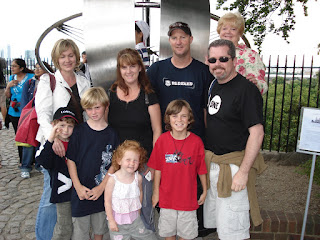
 All of us standing on the Prime Meridian at Greenwich Observatory
 Westminster from the Thames (we were on a boat)
 The kids came back after a long day and relaxed...by reading books.
 Very 'old school', don't you think?
 Even Bella (aged 3) got into the act.

 Garrett and Bella on the Tube.
 Gina and Connor enjoying the ride.
 The Tube can have a strange effect on people...
I thought they were supposed to have small cars over here!
 All of us standing on the Prime Meridian at Greenwich Observatory
 Westminster from the Thames (we were on a boat)
 The kids came back after a long day and relaxed...by reading books.
 Very 'old school', don't you think?
 Even Bella (aged 3) got into the act.

Next stop: PARIS
Subscribe to:
Posts (Atom)
